
Establishing the Impact of a Patient-Centered Pilot Cancer Survivorship Program to Enhance...
Feb 28, 2024 | Views:208822 |
 Print Version

Office of Research, Impact and Postgraduate Studies
presents
Establishing the Impact of a Patient-Centered Pilot Cancer Survivorship Program to Enhance Quality-of-Life among Breast Cancer Patients in Trinidad & Tobago with the Potential for Dissemination across the wider Caribbean Region
by Ms Kristy Samaroo
Cancer outcome is usually described in terms of survival, a quantitative construct based on time. Cancer presents many unanticipated challenges and stresses. Coping with these challenges impacts on the patients’ behaviour and general wellbeing; factors which are not generally measured in outcome. Enhancement of coping strategies in response to cancer could conceivably affect quality-of-life (QoL) during the cancer journey. This addition of QoL strategies to survival characterises ‘survivorship’. This study, funded by the Pan American Health Organization (PAHO), was aimed at the development of a Cancer Survivorship Program (CSP) to better the lives of cancer patients in Trinidad and Tobago, and by extension the Caribbean.
Breast cancer (BC) participants (eligible were females treated for invasive BC, aged 18-69yrs, n=52) were recruited from the St James Medical Complex, NWRHA, and pre-evaluated for baseline measurements (pre-CSP) related to survivorship. Participants were enrolled in a customised program designed to empower cancer patients to improve QoL and wellbeing through lifelong learning of coping strategies. Live interactive sessions on nutrition, psychosocial skills and spirituality, relaxation/mindfulness/yoga were delivered on a virtual platform. Participants were also evaluated after completing the CSP (post-CSP) to measure impact. Patients’ perception of survival, interest in survivorship and effectiveness of the programme were analysed by comparing pre-CSP to post-CSP mean scores on a range of 1 to 10 (paired t-test, p<0.001).
Significant differences were observed for all parameters measuring overall wellbeing, survivorship experience, psychosocial and spiritual wellbeing, nutritional health, and the ability to cope with challenges. Patients were able to differentiate between "Survival" (a time construct) and "Survivorship" (a QoL experience). Fifty participants (96 percent) commented on the need for the CSP and provided feedback on how the programme can be further optimised to offer more benefits to cancer patients’ education and support.
Apart from the demonstrated need, there was enthusiastic support for instituting the CSP, particularly the patient-to-patient interaction (enriching "extended family" concept). The patients considered the programme ‘empowering’ and recommended its wider dissemination. The needs for a lay description of breast cancer concepts and a Patient Navigator were highlighted. We plan to continue dissemination nationally and regionally considering these patients’ recommended refinements.
Wednesday 28th February 2024 at 1:00 p.m.

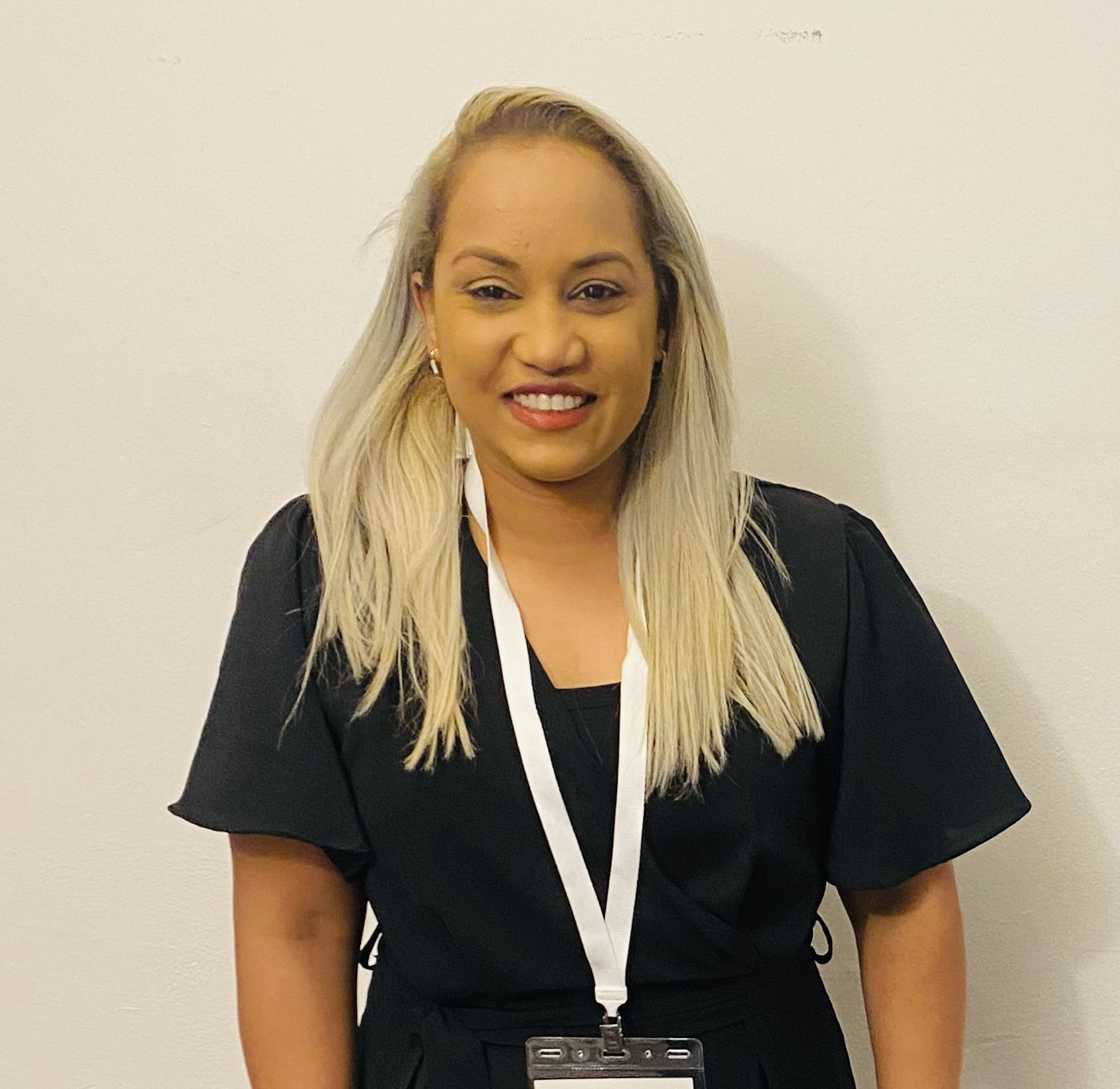
Ms Kristy Samaroo is very passionate about improving the quality of care among cancer patients in Trinidad & Tobago, and the Caribbean. She graduated as valedictorian with a Bachelor of Science (B.S.c) in Biomedical Engineering from The University of Trinidad and Tobago (UTT) and is currently pursuing her Master of Philosophy (M.Phil.) with a focus on Breast Cancer Survivorship.
Ms Samaroo completed the Patient Navigation Program at York University and is a member of the African Caribbean Cancer Consortium. Her research includes stems cells, tissue engineering and genetics. She is the Research Coordinator on multiple projects including a multinational cancer genetic study, the African-Caribbean Cancer Genome Registry spearheaded by Dr Sophia George, University of Miami and Dr Camille Ragin, Fox Chase Cancer Centre; and the Single Cell African-Caribbean Ancestry Network for breast, ovarian, endometrial, and prostate cancer funded by the Chan Zuckerberg Initiative as part of the prominent Human Cell Atlas study.
In the past, Kristy worked with Dr Amalia Hosein, Assistant Professor, UTT in the development of a mobile health application engineered to assess cardiovascular disease status among citizens of Trinidad and Tobago, through a PAHO-funded IS4H grant. She is currently coordinating the development of a Care Navigation Program for metastatic breast cancer patients in the Caribbean and has also worked under the mentorship of Professor Jameel Ali to pioneer the development of a Cancer Survivorship Program (CSP), that has been assessed for impact among a group of breast cancer patients at the St James Medical Complex. This PAHO-funded project aims to establish a patient-centered CSP in Trinidad and Tobago with the potential for expansion into the wider Caribbean region.
More Results


