
Eighteen Years Later: Trinidad and Tobago Faces an Unfinished Battle Against the Giant African Snail
Aug 28, 2026 | Views:351 |
 Print Version
This article is submitted by Dr Marcus Nicholas A. Ramdwar, Associate Professor, Biosciences, Agriculture and Food Technologies, UTT. Over the past eight years, Dr Ramdwar has researched the Giant African Snail, publishing extensively on its behavioural dynamics, invasive ecology, and sustainable management across Trinidad and Tobago and the Caribbean.
As the rains return to Trinidad and Tobago each year, so too does a familiar and increasingly persistent threat of the Giant African Snail.
For farmers, homeowners and communities across the country, the rainy season has become synonymous with the emergence and rapid proliferation of this highly invasive pest. Moisture-rich conditions provide the ideal environment for snail activity, allowing populations to expand quickly and increasing the risk to agricultural lands, residential communities, recreational parks, sporting fields and ornamental landscapes.
October 2026 marks eighteen years since the Giant African Snail was first confirmed in Trinidad following its initial detection in Diego Martin. Since then, the pest has spread across the island through numerous pathways, many facilitated by human movement and activities. Today, it is firmly established throughout Trinidad and has also been detected in several communities in Tobago.
Despite years of public awareness campaigns and various population control initiatives, the Giant African Snail remains an enduring national challenge. Its presence has become an annual reality, affecting both rural and urban communities alike.
For the agricultural sector, the threat is particularly significant. The Giant African Snail is a voracious feeder capable of attacking hundreds of plant species, including many economically important crops. Crop damage can reduce yields, increase production costs and place additional financial strain on farmers already facing mounting challenges. In residential areas, homeowners continue to battle infestations in gardens, yards and around buildings where damp conditions encourage snail activity.
However, the implications extend well beyond agriculture and household nuisance. The Giant African Snail poses a broader threat to food security, biodiversity, environmental sustainability and public health. Its continued spread demonstrates the enormous difficulty of managing an invasive species once it becomes widely established and highlights the need for long-term, coordinated action rather than isolated seasonal responses.
The annual resurgence of the snail should therefore serve as a reminder that this problem has not diminished. Instead, it has evolved into a persistent national issue requiring continuous monitoring, public education and collective participation.
Eighteen years after its arrival, the question facing Trinidad and Tobago is no longer simply whether the Giant African Snail can be eradicated. A more realistic and pressing question is how citizens, communities and institutions can work together to develop and sustain a comprehensive strategy capable of significantly reducing its population and slowing its continued spread.
One of the most promising approaches is early, coordinated intervention through community-based collection and the strategic use of molluscicide bait to reduce the breeding population. Monitoring should be central to this strategy, with particular attention paid to breeding-sized snails. Reducing the number of reproductively mature snails - especially those with shell lengths exceeding approximately four centimetres - can substantially limit egg production and slow future population growth.
Timing is equally critical. As snail activity increases with the onset of the rainy season, baiting and collection programmes should begin immediately and continue throughout the peak and latter stages of the wet season. Such sustained intervention has the potential to reduce the number of snails surviving into the 2027 dry season and, consequently, the breeding population that will emerge with the following year's rains.
Although several chemical companies now market products for snail control, the availability of bait alone will not solve the problem. Maximum impact will only be achieved through a well-coordinated national strategy that integrates timely bait application, continuous monitoring, community engagement and sustained public participation.
As the rains once again revive snail activity across Trinidad and Tobago, the experience of the past eighteen years offers an important lesson: this invasive pest will not be overcome through occasional interventions or individual efforts alone. Success will depend on sustained commitment, informed communities and a coordinated national response that transforms annual reaction into year-round prevention. Only through collective action can Trinidad and Tobago begin to meaningfully reduce Giant African Snail populations and safeguard its agriculture, environment and food security for future generations.
Learn more about UTT's Biosciences Agriculture and Food Technologies programmes by visiting www.u.tt/baft, calling 642-8888 ext. 23139 or emailing lygia.mitchell-smith@utt.edu.tt
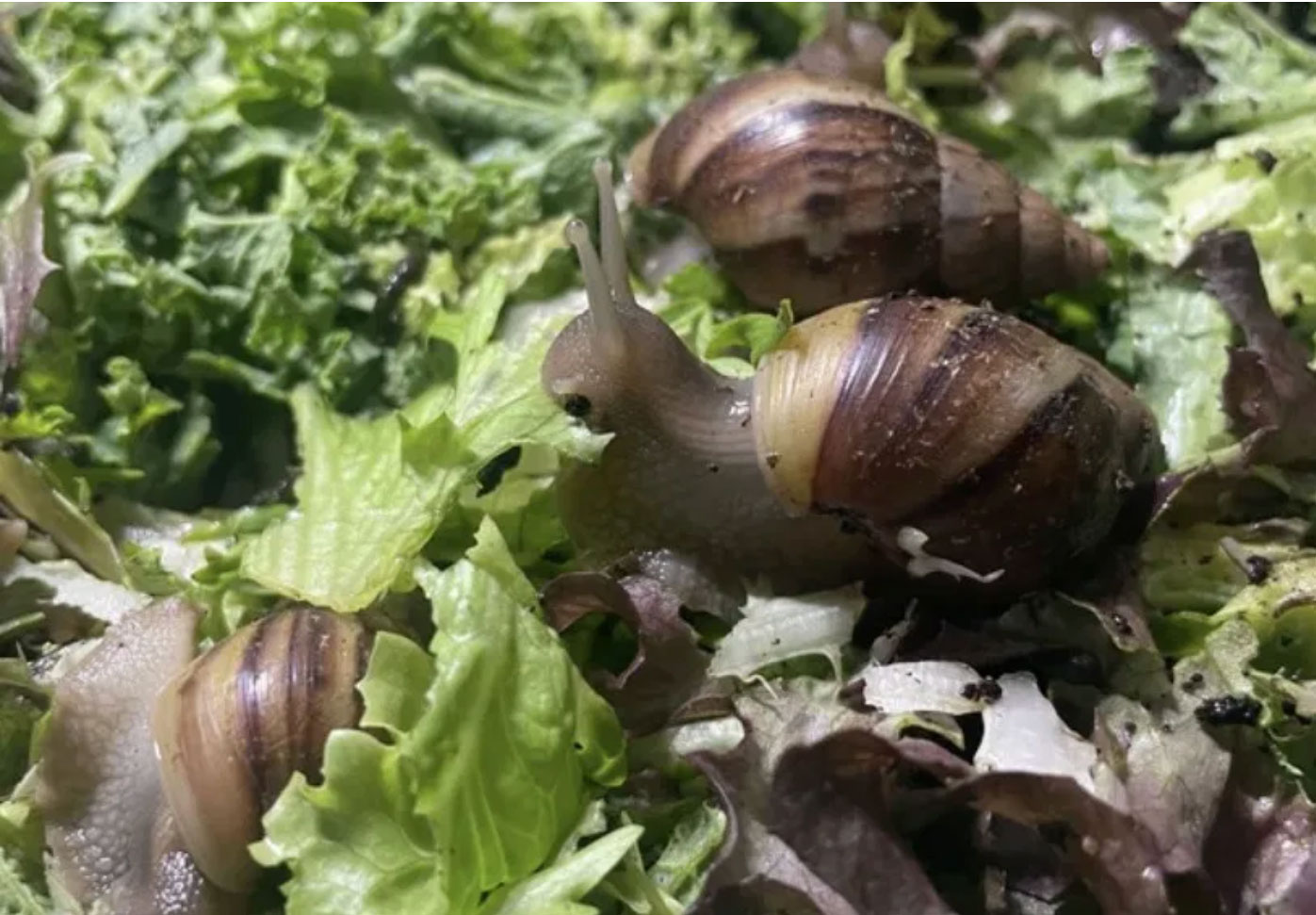
Photo caption: The devastating and devouring reality of the Giant African Snail's impact to Food Security.
More Results


