
U.S. Embassy and UTT Partners for Ocean Film Showcase in T&T
Mar 27, 2017 | Views:208787 |
 Print Version
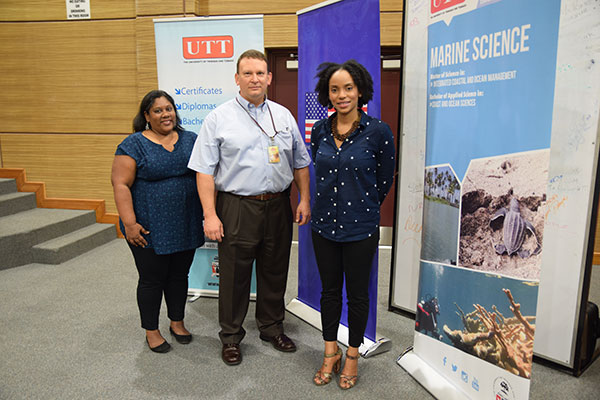 As part of World Earth Day observances on April 22, 2017, the U.S. Embassy and the UTT Marine Sciences programmes have partnered with the Jackson Hole Wild Film Festival, the DC Environmental Film Festival and the Blue Ocean Festival, to showcase several ocean documentaries that highlight the challenges facing ocean conservation and sustainable use of its resources.
Four (4) films have been selected and will focus on key issues facing our oceans with relevance to Trinidad and Tobago: Ocean Warriors is a six (6) part series that focuses on the battle to police our oceans; The Last Ocean examines the fate our oceans due to exploitation; Our Rising Oceans focuses on sea level rise; and A Plastic Ocean highlights issues related to pollution and plastics in our oceans.
The films will be screened throughout Trinidad and Tobago. The premiere, featuring the film Ocean Warriors was hosted at the UTT Chaguaramas Campus on March 22nd, 2017 with the U.S. Embassy’s Acting Deputy Chief of Mission Dexter Payne, leading a discussion on marine policy and the challenges facing ocean conservation.
These films are being used to raise awareness about our oceans which provide a host of goods and services that are necessary for life on earth, but which are being exploited and polluted. Some of these goods and services include: fisheries, provision of oxygen, carbon dioxide sink, weather control, and the water cycle. However, our uncontrolled actions have had a serious impact in the balance of these goods and services, affecting our health, our economies and our climate.
The effects of ocean pollution
Traditionally, marine fisheries have been located near the coast as it was more cost effective and more productive than the open ocean. It provided the primary source of protein across the globe. With increased pollution and overfishing, epipelagic and coastal fisheries are being depleted. This has resulted in an upwards of a 40% shift towards fishing in deeper waters.
Small photosynthetic plants called phytoplankton are estimated to produce over half the oxygen that we, and all other land animals, breathe. Further, the ocean waters are known as carbon dioxide sinks, and can absorb large amounts of this gas. However, with rising carbon dioxide levels, there is also rising acidification of our oceans, which itself has detrimental effects on carbon and shells (e.g. corals, snails and oysters), fish behaviour and photosynthesis.
Our oceans also play a vital role in the heating and cooling of our planet and cycling of water, both of which are extremely important in determining the world’s climate. As we change our atmospheric conditions, and our oceans warm, the glaciers and ice caps melt leading to rising sea levels.
One of the main sources of pollution to our oceans, besides excessive nutrients, is plastics. Plastics can be found in our rivers, beaches, nearshore oceans and the open ocean. It is perhaps the most visible of pollutants that we as humans have introduced into the oceans.
Our oceans are our priority!
The films will be available for showing until World Earth Day. If you are interested in having the film shown at a venue, please contact UTT Marine Sciences at Marine.Sciences@utt.edu.tt.
More Results


