
UTT's Mechanical, Manufacturing and Entrepreneurship Unit (MME): Solar Drying Project
Dec 22, 2020 | Views:209777 |
 Print Version
Research Team - Dr. Derrick Balladin, Dr. Aneil Ramkhalawan, Dr. Jorrel Bisnath, Dr. Edward Cumberbatch, Dr. Aatma Maharajh & Mr. Ronnie Bickramdass
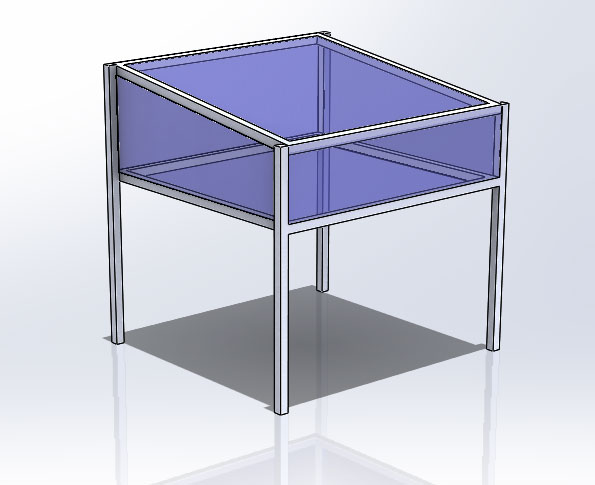
Project Overview
In October 2020, a group of researchers from the Mechanical, Manufacturing and Entrepreneurship Unit met with Ms Melanie Trim, Manager - Energy Resource Unit, Tobago House of Assembly. During these discussions, one of the problems identified was the need for a low-cost solution to help farmers preserve their produce for long term storage and resale to local, regional and international markets. A solar dryer was identified as a potential solution. The overall aim of this project is to create a simple, low-cost portable device that can be: (i) fabricated locally and (ii) easily operated and implemented by farmers.
Prototype Design
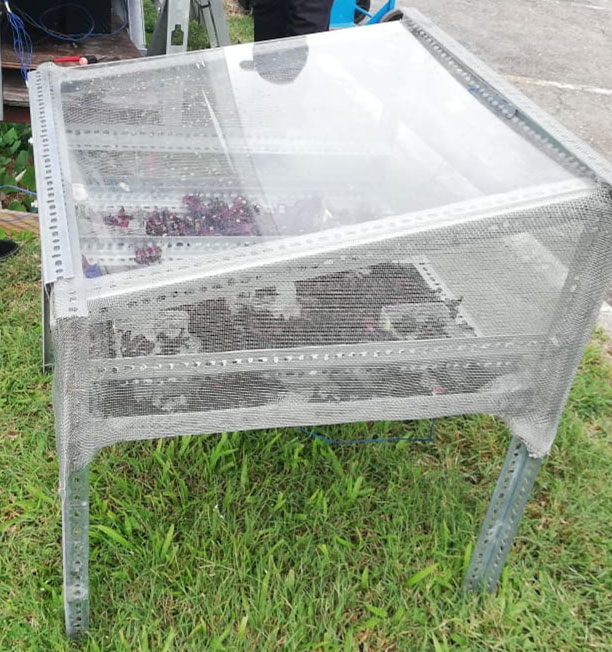
The Solar Dryer at testing facility at UTT San Fernando Campus

The Solar Dryer with a testing commodity
To inform the design and begin to understand the efficiency of solar dryers, an alpha prototype was created. The frame was constructed with slotted angle iron for ease of assembly or disassembly and also for ease of modification and/or reuse. Three millimetres square stainless-steel mesh was used to wrap the frame and prevent large insects and birds from accessing the items being dried. A clear acrylic sheet (plexiglass) was used to create a top cover to prevent rainfall from affecting the drying process, while allowing exposure to sunlight. The top cover was placed with a pitch of approximately 10 degrees to allow for run off of rainfall and to aid natural convection though the device.
Experimental Testing
For the pilot test on performance, locally produced sorrel was used in the dryer. A batch of freshly harvested sorrel was de-seeded and placed into the bed of the dryer. Five (5) sub sampling baskets were made using the 3mm stainless steel mesh. Samples of sorrel were added to each basket. These baskets were weighed daily to monitor moisture loss.

Sorrel being added to the dryer for testing
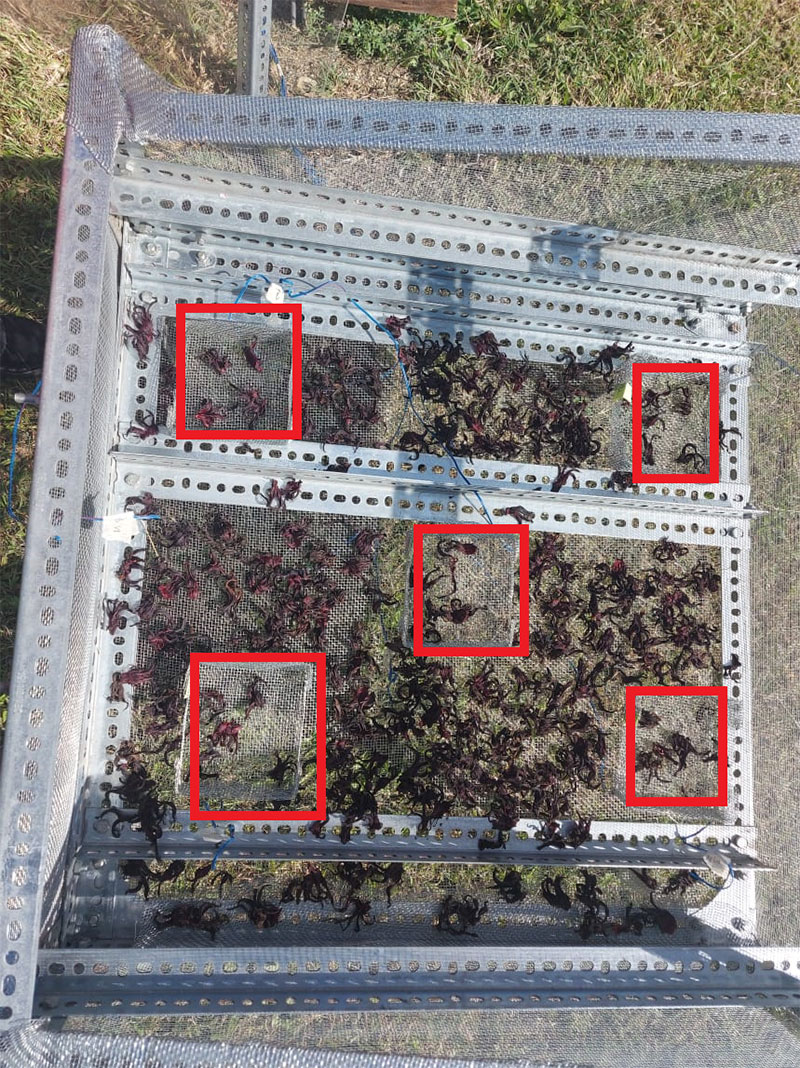
5 sub-sampling wire baskets located in the dryer
Temperatures within the drying chamber were monitored using Type -T thermocouples connected to a Campbell Scientific CR1000 data logger. The mean temperatures were recorded every minute and these were averaged and plotted every hour for the 3-day drying period. Under natural convection, the recorded temperatures within the dryer ranged from ambient at the inlet of the chamber to about 5°C above ambient within drying sorrel at the hottest part of the day. Brief temperature spikes of up to 39°C (8°C above ambient) were observed within the sorrel.
The CR1000 datalogger power was supplied by a BP375 p-Si PV module connected via a C-40 Xantrex charge controller to a Sunlyte 100 AH deep cycle battery and the PS100 Campbell Scientific power supply.
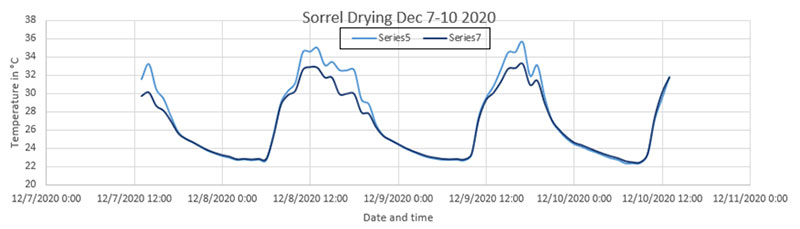
Sample temperature profile from inside the dryer
Initial Results and Conclusions
After 4 days, it was observed that the daily moisture loss started to level off. At this point the experiment was halted and a sample of the main batch of sorrel was taken for further analysis.
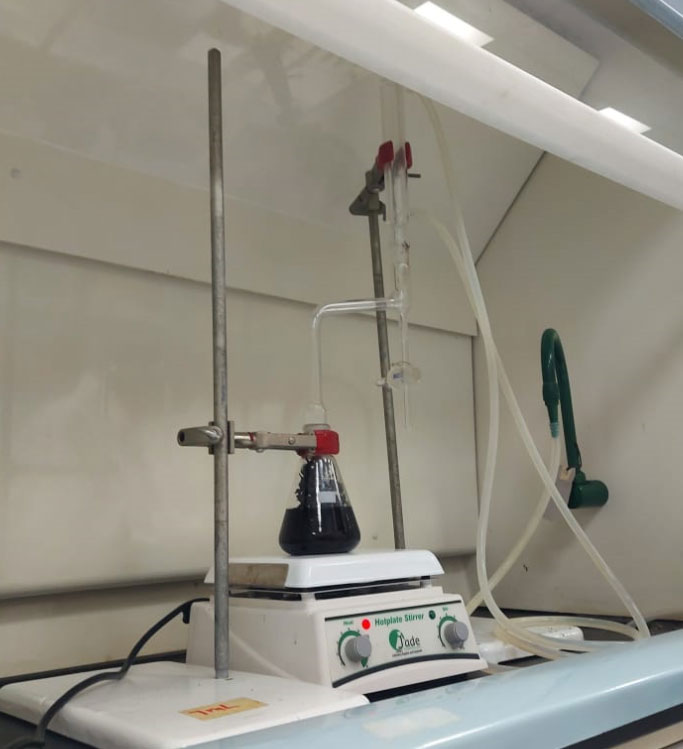
Final moisture content using the dean-stark procedure
Two parameters were considered to determine the dryer’s efficacy - moisture content (as determined by the Dean-Stark Method) and percentage change of mass. The moisture content was found to be 9.03%. For reference, a moisture content of less 10% is typically deemed acceptable for dried produce.
The percentage change of mass was 89.7%. Assuming that this is endemic of the performance of the dryer, when dried, a 5kg (11lb) bag of fresh sorrel would have a mass of approximately 0.52kg (1.1lb). From a retail and consumer standpoint, this is very important! The cost of shipping and transporting dried sorrel reduces significantly resulting in cost savings to both the farmer and the end consumer.
These results show that this dryer is a viable design. The device will now be subjected to a further redesign to optimise production costs and ease of manufacture before further testing.
More Results


