Mechanical Engineering, Manufacturing and Entrepreneurship
UTT's Medical Design Innovation group uses 3D Printing to create anatomical models
210138 views Print version (opens in a new tab)
UTT's Design Innovation group uses 3D Printing to create anatomical models
UTT’s Design Innovation research group is using 3D printing technology to create accurate physical models of patient anatomy. Dr. Umesh Persad, Assistant Professor of Design and Manufacturing Engineering, successfully printed various test models to demonstrate the utility of computational modeling and 3D printing technology in the local medical sector. The creation of physical anatomical models via 3D printing (also referred to as additive manufacturing) for surgical planning, implant design, patient education and medical education are not new concepts. However, for the first time, it is being done locally.
The Process
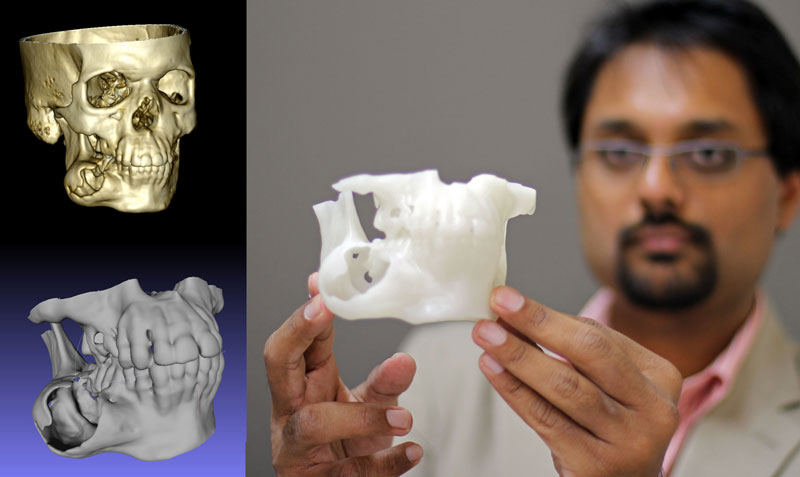
A first set of test bone models were created from an open-source anatomical database on the department’s 3D Systems Inkjet Z printer. These were used to demonstrate the technology to various medical practitioners. Then, in collaboration with Dr. Parmanand Maharaj and Dr. Alex Sinanan in the Department of Radiology at the Eric Williams Medical Sciences Complex, a patient’s computerised tomography medical imaging data set (CT scan) was used to construct a 3D digital model of the skull bone structures using various software tools.
The model features a neoplasm (tumour) on the lower jaw that causes bone erosion and also affects the dentition (structure and arrangement of the teeth). After editing the model to isolate the feature of interest, it was printed by a USA based 3D printing service using Stereolithography (SLA) technology and returned in a matter of days (SLA is not available locally). The model could now be used for surgical planning, prosthesis development, demonstration and teaching.
There are a range of 3D printing processes that could be used for anatomical models depending on the need. The type of process is chosen on a case by case basis, with some processes (such as Fused Deposition Modeling and Inkjet 3D Printing) being available locally and others (such as SLA and Polyjet) being available through foreign 3D printing services. Specialities that have benefitted from 3D printed models include orthopaedic, maxillofacial, dental, cardiac and reconstructive surgery.
Importance
This first milestone is important as it opens the door for local surgeons and healthcare institutions to explore digital reconstruction and 3D printing technology in their delivery of healthcare. The Department of Design and Manufacturing intends to continue working with local surgeons, radiologists and anatomists to further develop this area for the benefit of patients. Eventually, the aim is to enable surgeons to carry out pre-operative planning and personalised implant design using computational and physical models of patient anatomy, resulting in quicker and more reliable surgical procedures.
Acknowledgements
Dr. Persad would like to acknowledge his collaborators including: Dr. Parmanand Maharaj (Radiology), Dr. Alex Sinanan (Radiology), Dr. Marlon Mencia (Orthopaedic Surgery), Prof. Surujpal Teelucksingh (Adult Medicine), and Dr. Richard Bibb (Reader in Medical Applications of Design at Loughborough University's Design School).
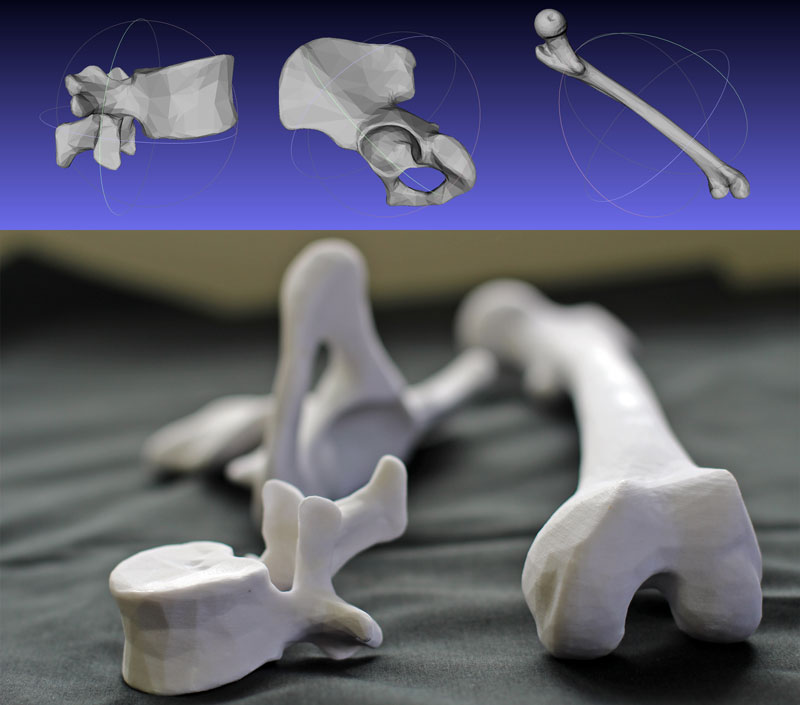
3D printed open source bone models
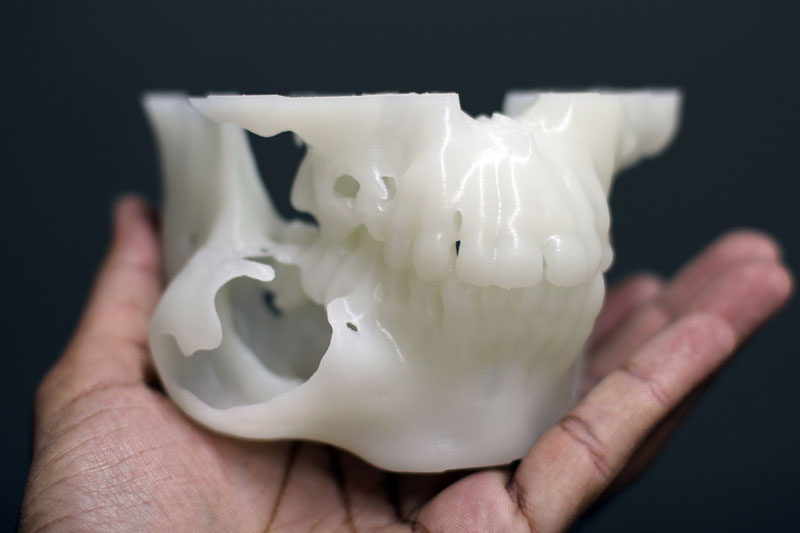
3D printed model of patient anatomy featuring a neoplasm (tumour) on the lower jaw