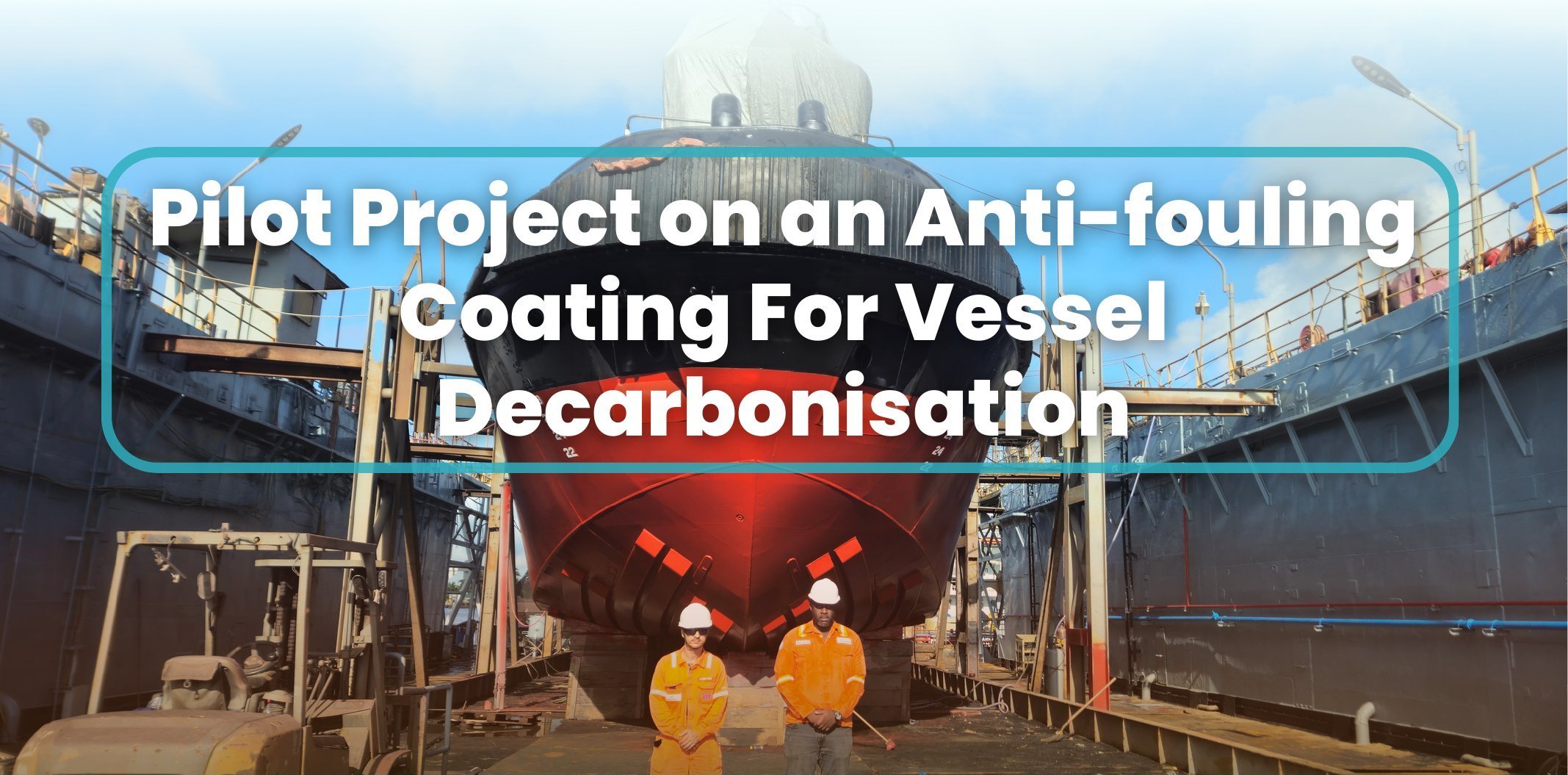
Trinidad and Tobago Pilot Project
Overview
The Trinidad and Tobago pilot project focuses on improving vessel energy efficiency through the application of advanced hull coating technology. This initiative aims to demonstrate how reducing hull resistance and biofouling can lead to measurable improvements in fuel efficiency and reductions in greenhouse gas emissions.
Project Objectives
Primary Objective:
- Demonstrate the technical and operational feasibility of an eco-friendly antifouling hull coating to reduce GHG emissions associated with the operation of the NEC Spirit.
- Monitor and quantify the GHG reductions achieved during the demonstration.
Secondary Objectives:
- Evaluate the potential scalability of the technology.
- Assess cost-effectiveness and return on investment.
- Gather and disseminate lessons learned for future large-scale deployment.
Scope
This pilot project involves the application of a sustainable and eco-friendly hull coating solution on the NEC Spirit. This initiative, under the IMO-EU GMN Phase II Project, is designed to advance the uptake of energy-efficient maritime technologies in the Caribbean through practical demonstration and results-based learning.
The scope of work includes the application of a graphene-based, antifouling coating during the NEC Spirit’s scheduled dry-docking. It also includes post-implementation monitoring and data collection to assess the coating’s impact on fuel consumption and GHG emissions. This technology is expected to reduce hull friction, thereby achieving fuel savings and a targeted reduction of up to 10% in GHG emissions under normal operational conditions.
Beyond GHG emissions reduction, the project aims to document the scalability and replicability potential of the solution across similar vessel types in the Caribbean region. Post-application monitoring, data collection, and verification of performance outcomes
Implementation Progress
The hull coating has been successfully applied to the selected vessel. The vessel is currently operating under normal service conditions with the new coating.
The project is now in the data collection phase, during which performance data, fuel consumption, and operational parameters are being monitored and analysed.
Status: Ongoing Phase: Operational Monitoring and Data Collection
Expected Outcomes
- Measurable reduction in fuel consumption
- Improved vessel operational efficiency
- Reduction in greenhouse gas emissions
- Evidence to support wider adoption of hull coating technologies