
Evaluating the performance of Photovoltaic (PV) Technologies in Trinidad and Tobago.
Jul 3, 2018 | Views:210904 |
 Print Version
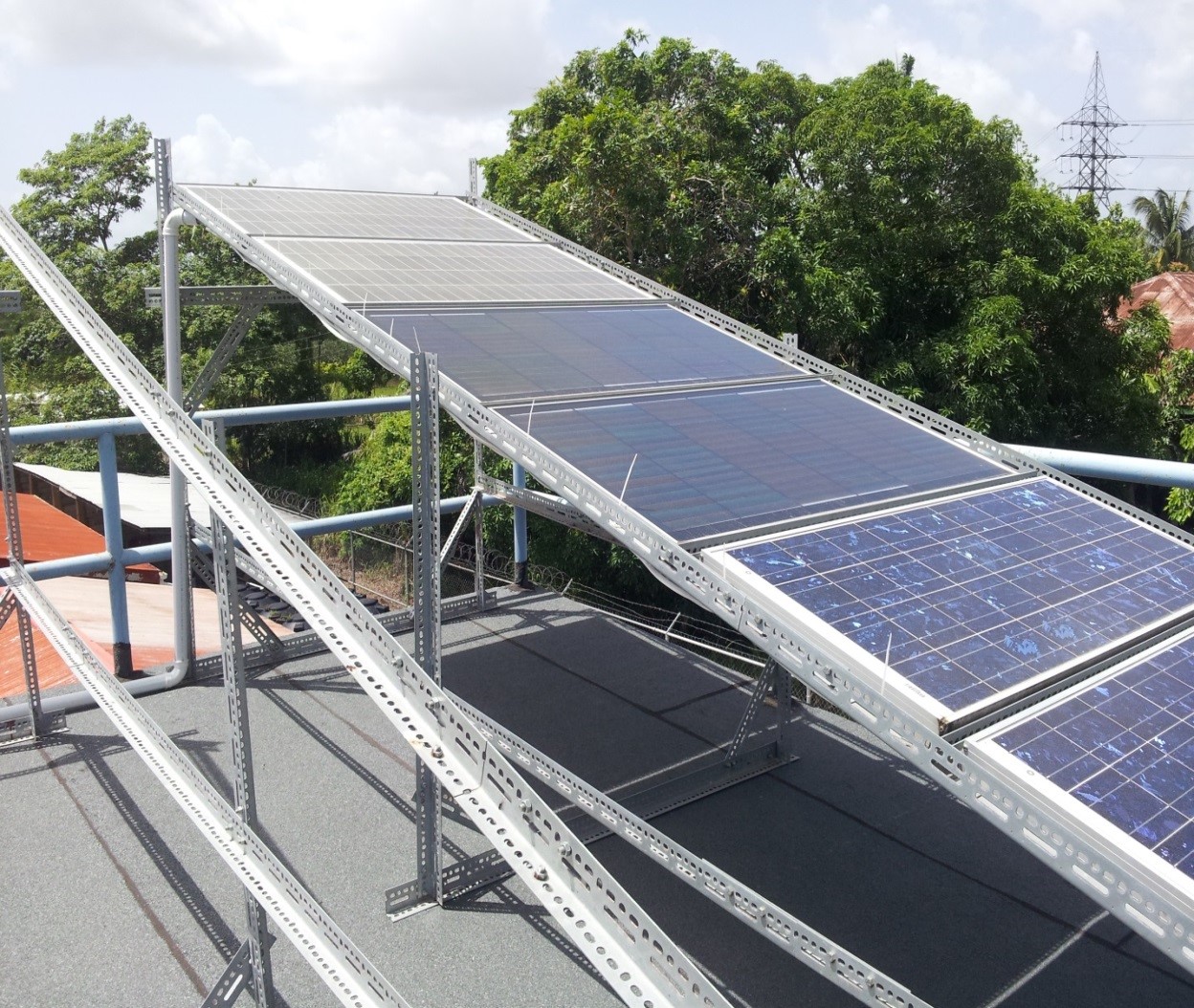
There are several photovoltaic technologies currently available and the literature has shown that some technologies perform better under certain conditions than others. These technologies have a range of efficiencies, sensitivities to temperature and type of radiation. Solar PV technology is destined to play a significant role in achieving the national Renewable Energy (RE) target of 10% penetration by 2021. The choice of PV technology best suited to the local conditions of Trinidad and Tobago can assist in attaining this goal.
An evaluation of the performance of three PV technologies was carried out at the Waterloo Campus of The University of Trinidad and Tobago by Dr. Edward Cumberbatch (Senior Instructor in Design and Manufacturing Engineering) as the focus of his doctoral research. Waterloo was selected as it is a coastal tropical location with a relatively high diffuse component of irradiance and high temperatures. The PV modules evaluated were polycrystalline silicon (p-Si), Copper Indium Gallium Diselenide (CIGS) and spherical silicon (sph-Si). The efficiency and performance ratio of each technology were calculated and compared with various environmental parameters.
Unlike several of the previous studies comparing traditional crystalline silicon modules with thin film modules under humid tropical conditions, the Waterloo results indicate that p-Si modules outperformed the other technologies except during mid-afternoon high temperature and low angle of incidence (AOI) conditions. Analysis of results showed that parameters solar irradiance and humidity were among the highest predictors of output power cluster assignment. The use of humidity, a commonly logged weather parameter, can greatly simplify the process of predicting the output of PV modules locally. This in turn may facilitate grid management once a significant portion of its inputs are from Renewable Energy (RE) sources.
Biography
 Edward Cumberbatch is a graduate of Anderson University in Indiana, USA where he obtained a BA in Physics with Mathematics and Music. He next graduated from Purdue University in Indiana, USA with an MSc in Physics. Subsequently he graduated from The University of the West Indies, St. Augustine Campus, with an MPhil in Solar Energy. He taught Mathematics and Physics at St. Mary’s College for many years before coming to The University of Trinidad and Tobago (UTT) as a Senior Instructor where he has taught Engineering Mathematics since 2006. He has been on the Examining Team for CSEC Physics since 2006 and is currently the Chief Examiner. He has just completed his PhD in Solar Energy in the Manufacturing and Design Engineering Programme at UTT.
More Results


