
The Caribbean Academy of Fashion and Design Builds Prototype to Extract Fibres from Pineapple Leaves
Apr 20, 2018 | Views:212502 |
 Print Version
In August 2017 a MoU was signed between UTT's Caribbean Academy of Fashion and Design (CAFD) and the School of Sustainable Design Engineering University of Prince Edward Island (UPEI).
This was a collaboration initiated by Professor Valerie Stoute in 2017. Several departments were given an opportunity to present research projects to the team from UPEI. A few months later, two projects were chosen by the team from UPEI; one from the Fashion Academy and the other from Animation.
CAFD has been involved in research and development of Eco-Textiles, namely Pineapple and Banana textiles for over five (5) years. The global fashion industry is moving towards sustainability, and designers and manufacturers are looking at ways of reducing the large carbon footprint caused by pollutants in the industry.
In September 2017, the UPEI team worked alongside CAFD to develop a design solution to effectively extract the pine fibres from pineapple leaves, which reduces the labour and time demands of their current methods. It is important that CAFD can efficiently produce the pine fibres for use in the manufacturing of women's clothing and fashion accessories, which is a large part of the focus.
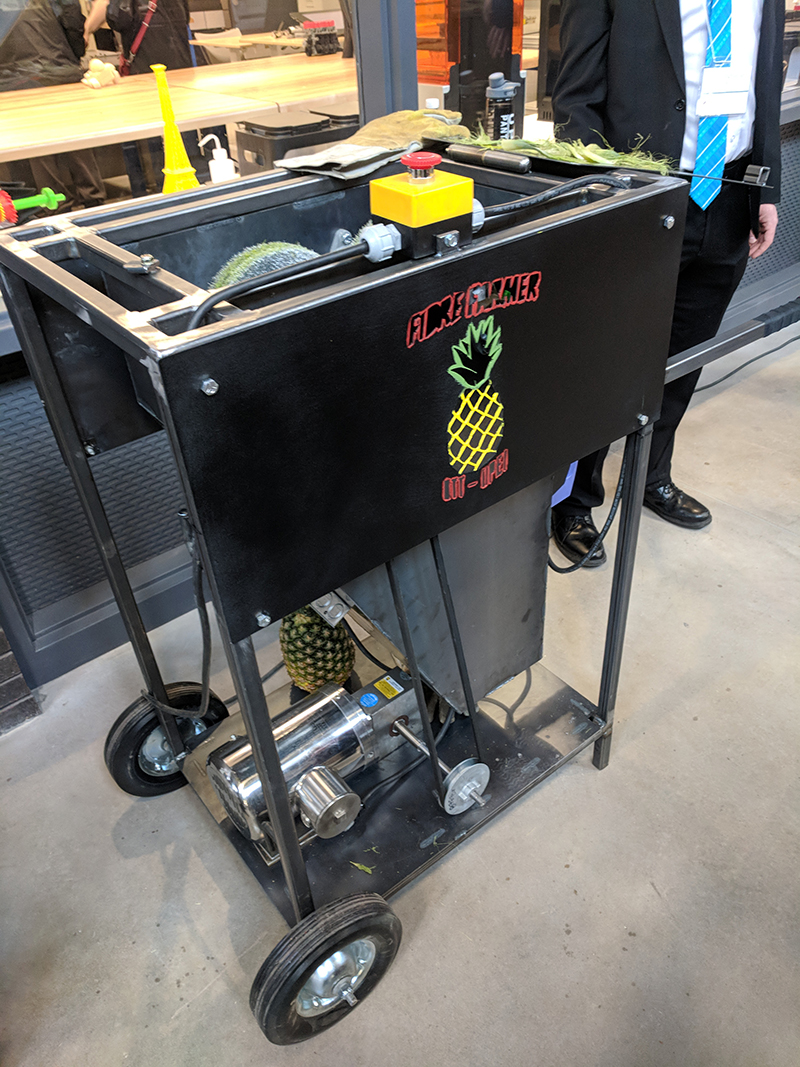
The UPEI team proposed three (3) initial design solutions and presented them to CAFD. These propositions included a handheld tool that improved upon the existing hand tools used, a “spinning drum” that used a hand crank to rub the leaf along a rough surface, and finally, the design shown here that was agreed upon by both CAFD and UPEI.
This design aims to increase the efficiency and reduce the labour requirements of extracting the useful fibres from the leaf, depositing the pulp in a compartment to be thrown away. This can be done with a design that incorporates two wire rollers that spins in opposite direction during operation, allowing the user to hold the leaf so that the wheels will pull the pulp. This is an apt alternative to using hand tools, such as a ceramic plate to repeatedly press over the leaf until all the pulp has been removed, which has proven to be extremely time consuming based on research and tests by the team.
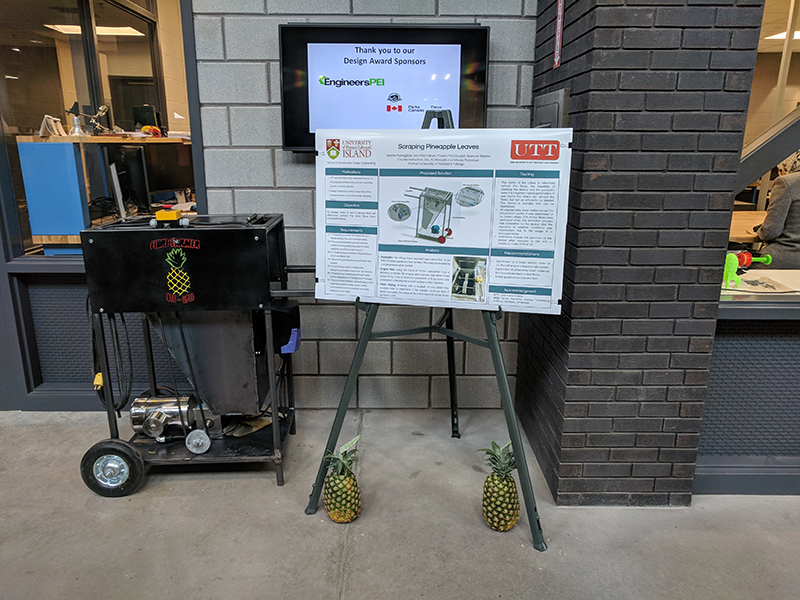
The prototype is a full-scale machine that can be easily implemented into the required setting. Constructed of structural steel and steel sheeting, it can stand up to rigorous use. A dedicated container catches the pulp inside the machine, to later be removed and discarded appropriately. An electric motor is used to power the device's operation and is mounted at the base.
The team at UPEI School of Sustainable Design Engineering was able to work alongside the faculty at CAFD to fulfil the requirements regarding the design process, resulting in a workable prototype.
More Results


