
UTT’s M.Sc. Innovative Design and Entrepreneurship (IDE) students publish journal paper on the Role of Engineering in the Design
Nov 14, 2017 | Views:212218 |
 Print Version
Students of the UTT M.Sc. Innovative Design and Entrepreneurship (IDE) programme in the Department of Design and Manufacturing Engineering have published their first journal article titled “The Role of Engineering in the Design of Kings of Carnival Costumes in Trinidad and Tobago” in the West Indian Journal of Engineering (to appear in 2018). The paper resulted as part of their course work investigating the needs of the local Carnival design industry in Trinidad and Tobago. The student team was comprised of Jameel Babooram, Kern Boyd, Fawwaaz Abdool, Sean Archie, and Solomon George under the supervision of Dr. Umesh Persad, Assistant Professor and Coordinator of the M.Sc. IDE.
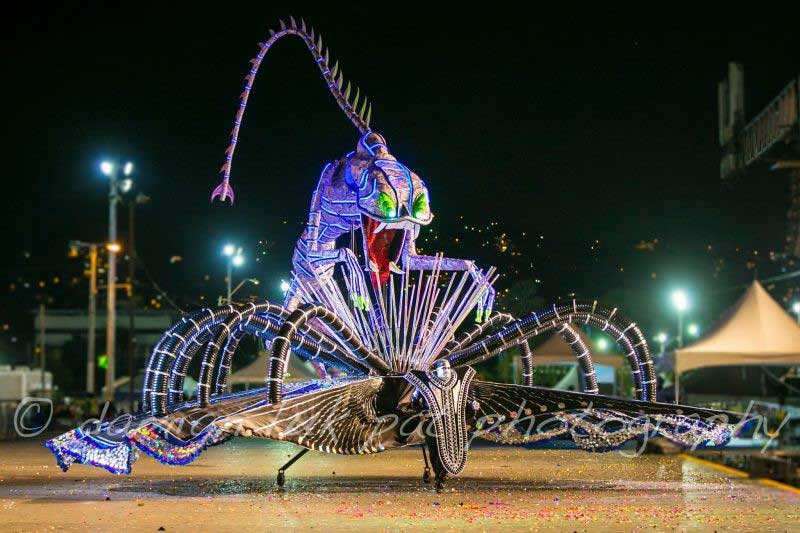
Information is lacking on the design process and key design issues faced by Kings of Carnival costume designers in Trinidad and Tobago. Unlike parade floats, Kings of Carnival costumes consist of large decorative pieces mounted on a three-wheeled frame that is moved around by a single masquerader who enacts a stage performance with the costume. To address this problem, a qualitative study was conducted through semi-structured interviews involving fifteen (15) Kings of Carnival costume designers within the last three (3) years. The study sought to identify the design process used, extract the factors that influence the design of the costumes, examine the extent to which Engineering principles are utilised, and recommend strategies for improving the design process.
Results indicated that engineering input was not utilised in the costume design process and material selection was based on tradition, availability and cost. Designers did not take into consideration the mechanical properties of materials during the construction of costumes. This resulted in a lot of trial and error during the construction and extremely heavy and uncomfortable costumes. External factors such as wind and rain were not being adequately addressed in the design process resulting in sub-optimal and unreliable designs.
Five recommendations were developed to improve the design process:
Recommendation 1: Produce Educational Materials for Design Process Improvement
Given that the current costume design process lacks structure and is sub-optimal, there is a need to educate practicing designers on the principles of good design and methods for the different phases of the design process. This would lead to cost effectiveness and more innovative costume designs. To combat the resistance to change, engineers should reach out and work with leading costume designers to partner with them in the development of training materials.
Recommendation 2: Design and Engineering Workshops for Costume Designers
There are currently no workshops focused on introducing simple engineering methods to costume designers. Recommendation 1 would feed into this recommendation where targeted short workshops should be carried out by engineers for costume designers. Workshops can provide a forum for designers and engineers to work together and allow them to build relationships.
Recommendation 3: Develop Modular Structural Costume Design Platforms
Current costumes are mostly built up from scratch every year making assembly, disassembly and transportation unpredictable and difficult. Most current designs already utilise a core upon which additional pieces are attached. This concept could be extended to form a general design approach for modularity.
Recommendation 4: Investigate New Materials and Construction Methods
New materials and construction methods need to be presented to designers with ideas on how they can be utilised to serve the creative process. This may be controversial as the materials used are considered part of the art-form itself e.g. wire bending. However, the aim should not be to replace all traditional materials, but demonstrate new ways of working with these materials in addition to selecting new materials, and also how to utilise processes such as 3D Printing and prototyping.
Recommendation 5: Analyse Costume Designs for Functional Performance
This recommendation seeks to address the issue of environmental factors particularly wind and rain which have been highlighted as factors which cause the most problems. Many costumes are designed with large plumes and moving parts, resulting in a large surface area for wind forces to act. Through design simulation (fluid dynamics) or the testing of small prototypes, the effects of wind loads could be reduced. There is also scope for the development of simple and usable CAD and Engineering analysis software for the carnival costume design sector.
The authors would like to thank all the costume designers who agreed to participate in the study, giving of their time and experience to advance the art of costume design. It is hoped that this study would be the first step in developing the technical expertise of the local costume design sector.
Author Biographies
Dr. Umesh Persad is an Assistant Professor in Design and Manufacturing at The University of Trinidad and Tobago. He obtained his BSc. in Mechanical Engineering (First Class) from The University of the West Indies, and his Ph.D. from The University of Cambridge in the area of Engineering Design, with a special focus on Inclusive Design.
Jameel Babooram obtained his Bachelor of Applied Technology (Mechanical Engineering) from The University of The West Indies. He is currently a candidate in the M.Sc. Innovative Design and Entrepreneurship programme at The University of Trinidad and Tobago.
Kern Boyd obtained his Bachelor of Applied Science in Utilities Engineering Electrical Option Cum Laude from The University of Trinidad and Tobago. He is currently a candidate in the M.Sc. Innovative Design and Entrepreneurship programme at The University of Trinidad and Tobago.
Fawwaaz Abdool obtained his Bachelor of Science in Physics with a Minor in Medical Physics and Bioengineering and Environmental Physics from The University of The West Indies. He is currently a candidate in the M.Sc. Innovative Design and Entrepreneurship programme at The University of Trinidad and Tobago.
Sean Archie obtained his Bachelor of Science in Mechanical Engineering from Carnegie Mellon University. He is currently a candidate in the M.Sc. Innovative Design and Entrepreneurship programme at The University of Trinidad and Tobago.
Solomon George obtained his Bachelor of Applied Science in Utilities Mechanical Option at The University of Trinidad and Tobago. He is currently a candidate in the M.Sc. Innovative Design and Entrepreneurship programme at The University of Trinidad and Tobago.
More Results


